Why Optical I/O?
The Interconnect Context of AI Systems
Why Optical I/O?
AI systems are scaling beyond single-chip performance
AI training and inference are evolving toward large-scale, tightly coupled systems, where overall performance is increasingly determined by interconnect bandwidth, latency, and energy efficiency.
Electrical interconnects are reaching physical limits
Traditional electrical interconnects face fundamental limitations in bandwidth, reach, power consumption, and thermal scalability, making them difficult to sustain GPU-to-GPU scaling.
Optical I/O is emerging as a key enabler — but form factor matters
Optical I/O is emerging as a critical path to overcome interconnect bottlenecks. However, fixed form-factor optical solutions struggle to adapt to diverse computing architectures and packaging requirements.
Future AI interconnects require architectural flexibility
To support scalable AI systems, optical interconnects must evolve toward more modular, architecture-aware, and packaging-flexible implementations.
Why Optical I/O?
AI systems are scaling beyond single-chip performance
AI training and inference are evolving toward large-scale, tightly coupled systems, where overall performance is increasingly determined by interconnect bandwidth, latency, and energy efficiency.
Electrical interconnects are reaching physical limits
Traditional electrical interconnects face fundamental limitations in bandwidth, reach, power consumption, and thermal scalability, making them difficult to sustain GPU-to-GPU scaling.
Optical I/O is emerging as a key enabler — but form factor matters
Optical I/O is emerging as a critical path to overcome interconnect bottlenecks. However, fixed form-factor optical solutions struggle to adapt to diverse computing architectures and packaging requirements.
Future AI interconnects require architectural flexibility
To support scalable AI systems, optical interconnects must evolve toward more modular, architecture-aware, and packaging-flexible implementations.
Our Technology Approach

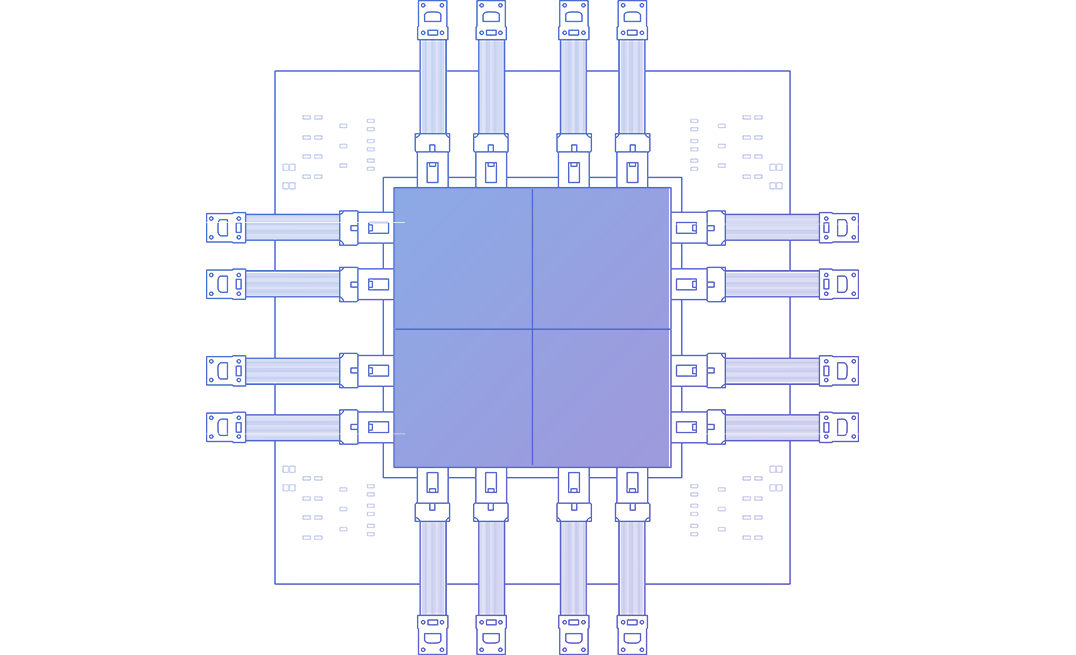
PhotonicX AI adopts an optical I/O chiplet architecture that modularizes interconnect capabilities and brings optics closer to the compute core.


By shortening electrical paths and enabling flexible packaging integration, this approach delivers scalable, low-latency, and energy-efficient interconnects for AI systems.

Key Technical Advantages
Independent Optical  I/O Chiplet
Independent Optical I/O Chiplet
Modularizes optical I/O into independent OE chiplets for flexible integration across different architectures and packaging form factors.
Optoelectronic Co-Design & Advanced Packaging
Co-optimizes photonics, electronics, and packaging to balance bandwidth density, power, and reliability at the system level.
Semiconductor-Process for Scale & Evolution
Built on process maturity and manufacturability to support scalable deployment and long-term technology evolution.
System-Level Benefits
These advantages form the foundation for scalable AI interconnect architectures across scale-up and scale-out systems.
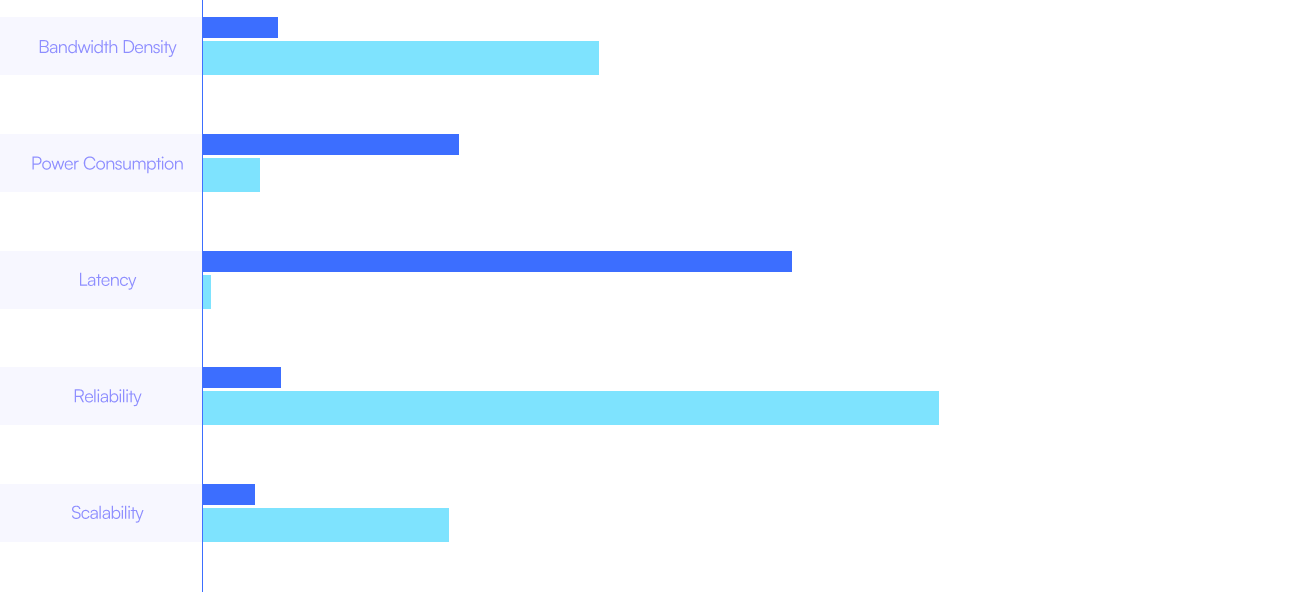
×10
Higher Bandwidth Density
×5
Lower Interconnect Power Consumption
×100
Lower Interconnect Latency
×10
Improved System Reliability

These benefits translate directly into more efficient, scalable,

and reliable AI computing systems.

System-Level Benefits
Bandwidth
Scalability
Reliability
Latency
Power Consumption
Electrical Interconnec
Optical I/O Architecture

Compared with traditional interconnect approaches, PhotonicX AI’s chiplet-based optical I/O delivers clear advantages across bandwidth density, energy efficiency, latency, reliability, and packaging flexibility—while maintaining the capability of mass manufacturing and deployment.

Related Products
Optical I/O Chiplets (NPO/CPO/XPO)
A chiplet-based optical I/O solution delivering high bandwidth density, low latency, and low power comsumption optical interconnects for AI computing.
Chiplet-based optical I/O
Multiple packaging support (NPO/CPO/XPO)
High bandwidth density, low latency, and low power consumption
Learn More
High-Speed Silicon Photonics Chips
High-speed silicon photonics chips for next-generation optical transceivers, enabling efficient electro-optic and opto-electronic conversion with high bandwidth, high linearity, and high integration for 1.6T and beyond.
High integration
Large bandwidth
High linearity
Learn More
High-Speed Electrical ICs (Driver/TIA)
High-speed electrical Ics, including Drivers and TIAs, designed to ensure signal integrity and energy efficiency for 1.6T optical transceivers and beyond.
High-performance Driver & TIA
Signal integrity optimization
Energy-efficient analog design
Learn More
Contact Us
First Name
Last Name
Email
Company
Job Title
Phone
Message